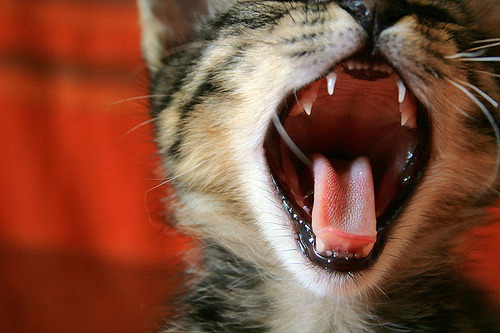
Your cat may have learned that if she meows, people will talk to her, play with her, feed her, or even yell at her (trust me, I know this first hand). Remember for some cats negative attention is better than none at all. Some owners love to “talk” with their cats, back and forth, so if you have adopted your cat as an adult, it is possible that this behavior was encouraged by a prior owner. If you have brought Kitty up, then most likely you can think of things that have “rewarded” this behavior. Cats learn to communicate with us, just as we learn to communicate with them. Maybe when the litterbox is dirty, your cat draws your attention to it by walking around and meowing, and so you clean the box. This is how behavior patterns start.
Cats also meow to express discomfort or pain, agitation, and in some cases, territoriality. Unneutered (intact) male cats may yowl in conjunction with sexual behavior, and female cats in heat may meow excessively as well.
If you have a chatty cat, how can you stop or at least curb this habit?
Do Not Reward
This should be the backbone of your behavior modification plan. Pay attention to your kitty when she is being quiet, wait for a moment of silence before you feed her. Ignore her when she meows. If you are having trouble sleeping at night, you can try earplugs, or pulling the cover up over you head! Or you could close the door to your bedroom. Remember that if you break down and give your kitty attention, you will have to start all over again. For more information on how to prevent nighttime or early a.m. wakings, please ask for our handout on nocturnal kitties.

Make Sure Your Cat’s Needs Are Met!
Cats need attention and interaction, so make sure that somewhere in your daily schedule you allot times for play and petting. Cats like routine and will meow excessively if their routine is upset, so do try to do everything, especially if it’s cat related such as feeding and changing the litterbox, on a set schedule as much as you are able. Provide your cat with stimulation. Keeping your cats indoors is much safer, but they will need to be entertained and encouraged to exercise. Even indoor-outdoor cats need owner interaction and stimulation. New toys, bought or made, food cubes that make Kitty work to get her food, and the occasional catnip toy help keep her from getting bored. Interactive playtime is the best kind of playtime for cats- toys like fishing-pole toys that your cat can chase could be integrated into a daily routine. Make sure your cat has a clean litterbox, and fresh water at all times. Make sure her diet is adequate. .
Be Patient!
It takes time for cats to learn behaviors, and often takes even more time to unlearn them. In order to make a change in your cat’s meowing, you need to be very consistent and give your cat time to adjust.
Recognize When A Behavior Is Not Likely To Change:
You may be able to reduce the amount of attention-getting meowing or feeding-time meowing by ignoring, and feeding and playing at set times, but this will not cure a hard-core talker such as some Siamese or Siamese mix breeds are. These behaviors are characteristic of some breeds, and are not likely to go away in their entirety.
THESE SITUATIONS REQUIRE A DIFFERENT RESPONSE
If Your Cat Is Grieving:
If your cat has recently lost a companion, feline or human or even canine, he may walk around the house and meow, perhaps in search of them or just reacting to the change. While you don’t want to reward the meowing, it is important to give your cat extra reassurance in these cases, spending quality time, preferably on a schedule, until he adjusts to his loss.
If You Have Just Moved To A New Home, Or Have Just Brought A Cat Into Your Home:
It is normal, especially for an adult cat, to be disoriented and unsure in a new environment. Introducing your cat to the house gradually may help prevent some agitation (see our handout on introducing a cat to a new home.) Again, don’t reward the meowing, but be a little understanding in these instances. This behavior usually takes a few weeks to wind down.
If Your Normally Quiet Cat Has Become Very Vocal:
Make sure there is nothing medically wrong with her; schedule a check-up with your vet. Pay attention to environmental changes to see if something could be bothering her, such as a new stray cat coming by your back door.