Showing posts with label appetite. Show all posts

Wednesday, August 19, 2009

Aloha For Me... Alone Time for Her


By Daniel Quagliozzi


All of us deserve a vacation once and a while. Just some time to get away and go somewhere else, without a care in the world. But, as a cat guardian, it's often very hard to step away from our homes for more then a few days without calling in reinforcements to take care of our furry friends, while we bask in the sun or hike a mountain trail, miles away from home.
donnamatilda2


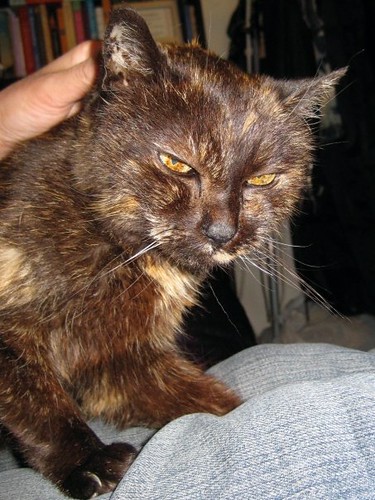
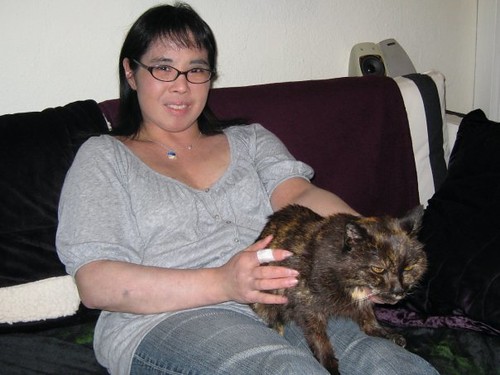
I am extremely fortunate to have friends and colleagues at the SF/SPCA that are available to look after my senior cat, Matilda. In her golden years, Matilda is not the kind of cat that you can just put out a fresh bowl of food and water and leave. She requires a savvy cat sitter who knows her well and can tell if she's feeling a little wonky. With cognitive dysfunctions, spinal arthritis, intermittent vomiting, low appetite and the need for subcutaneous fluids every few days, Matilda is quite the challenge to care for. Again, I am extremely lucky to have a great cat sitter that not only gives her love and attention, but was kind enough to document each day with pictures!

donnamatilda

World's Best Cat Sitter : Donna watches over my broken down cat Matilda


If your cat is lower maintenance, the best thing to do for long absenses is to ask friends or hire a pet sitter to check in – to feed and provide fresh water, clean the litterbox, and groom your cat at least once a day. Ask them to engage in some interactive playtime with your cat. It will provide exercise and mental stimulation, and the exercise can reduce stress. Someone who is familiar with your cat is ideal.

If you are going away for more than 2 weeks, it is best to have someone who can spend the night at least a few times a week while you are away.

When hiring a cat-sitter:

  • Get references from friends, your vet, or local animal rescue.


  • You may prefer to use a pet-sitter who is bonded and insured, and they should offer you references if requested.


  • Ideally, have the pet-sitter meet your cat before you hire them, to see how they interact with your cat.


  • Make reservations early, as pet-sitters can get booked up quickly, especially during holidays.


  • Leave carefully written instructions for the sitter about where food, litter and medications are located. Also note your cat’s preferences for grooming, treats, affection and interactive play.


  • Buy extra supplies in case your travel plans change.


  • Make sure your cat has an ID tag and microchip. Have current photos available in case she gets lost while you are gone.


  • Have a friend who has a back up set of keys and is willing to be an emergency contact.
    Make sure the pet sitter has your contact information for the duration of your travels.


  • Have a written letter authorizing the pet sitter to approve emergency veterinary care in your absence.

  • A written contract outlining fees, method of payment, and the terms of the services offered (amount of time spent with pet, time of day they will visit, other services they will provide such as checking mail or watering plants) is recommended

Boarding


Sometimes there is no choice but to board your cat. Boarding can be stressful, as your cat will be out of their familiar territory, surrounded by strange people, noises, and smells. If you must board your cat:

  • Call ahead of time; kennels book up quickly during holidays.
    Many vet offices and animal hospitals also do boarding.


  • Visit the kennel before committing.
    Many kennels require proof of up-to-date vaccinations, so inquire ahead of time about what shots your cat might need.


  • It’s best to bring along familiar items for your cat – bedding, something with your scent, toys and whatever food they currently eat. Also bring along any medications your cat needs.


  • Give the kennel detailed information about your cat’s preferences and needs, as well as your contact information.

If your cat is staying at someone else’s house…


Although not ideal, sometimes you have to take kitty to another home to stay. A “safe room” should be provided for your cat – away from noise and other animals. Some cats will need to stay in one room for the duration of the visit, depending on how outgoing (or shy) your cat is and how comfortable they are with strangers, other animals, and new environments. Security is a big issue, so make sure there is no chance for your cat to escape (through open windows, cat doors or other doors left open) – if she does she will be lost and far from home.

Friday, August 14, 2009

I Love You, But Please Be Quiet!

Though cats communicate mostly by body language, some cats “talk” more than others. This is could be genetic (some breeds, such as the Siamese, are especially prone to this) and partly a learned behavior. It's even been said that cats have a Manipulative Meow!

meow


Your cat may have learned that if she meows, people will talk to her, play with her, feed her, or even yell at her (trust me, I know this first hand). Remember for some cats negative attention is better than none at all. Some owners love to “talk” with their cats, back and forth, so if you have adopted your cat as an adult, it is possible that this behavior was encouraged by a prior owner. If you have brought Kitty up, then most likely you can think of things that have “rewarded” this behavior. Cats learn to communicate with us, just as we learn to communicate with them. Maybe when the litterbox is dirty, your cat draws your attention to it by walking around and meowing, and so you clean the box. This is how behavior patterns start.

Cats also meow to express discomfort or pain, agitation, and in some cases, territoriality. Unneutered (intact) male cats may yowl in conjunction with sexual behavior, and female cats in heat may meow excessively as well.

If you have a chatty cat, how can you stop or at least curb this habit?

Do Not Reward

This should be the backbone of your behavior modification plan. Pay attention to your kitty when she is being quiet, wait for a moment of silence before you feed her. Ignore her when she meows. If you are having trouble sleeping at night, you can try earplugs, or pulling the cover up over you head! Or you could close the door to your bedroom. Remember that if you break down and give your kitty attention, you will have to start all over again. For more information on how to prevent nighttime or early a.m. wakings, please ask for our handout on nocturnal kitties.


cat_meow_119801gm-a

Make Sure Your Cat’s Needs Are Met!

Cats need attention and interaction, so make sure that somewhere in your daily schedule you allot times for play and petting. Cats like routine and will meow excessively if their routine is upset, so do try to do everything, especially if it’s cat related such as feeding and changing the litterbox, on a set schedule as much as you are able. Provide your cat with stimulation. Keeping your cats indoors is much safer, but they will need to be entertained and encouraged to exercise. Even indoor-outdoor cats need owner interaction and stimulation. New toys, bought or made, food cubes that make Kitty work to get her food, and the occasional catnip toy help keep her from getting bored. Interactive playtime is the best kind of playtime for cats- toys like fishing-pole toys that your cat can chase could be integrated into a daily routine. Make sure your cat has a clean litterbox, and fresh water at all times. Make sure her diet is adequate. .

Be Patient!

It takes time for cats to learn behaviors, and often takes even more time to unlearn them. In order to make a change in your cat’s meowing, you need to be very consistent and give your cat time to adjust.

Recognize When A Behavior Is Not Likely To Change:

You may be able to reduce the amount of attention-getting meowing or feeding-time meowing by ignoring, and feeding and playing at set times, but this will not cure a hard-core talker such as some Siamese or Siamese mix breeds are. These behaviors are characteristic of some breeds, and are not likely to go away in their entirety.


THESE SITUATIONS REQUIRE A DIFFERENT RESPONSE


sadcat2


If Your Cat Is Grieving:

If your cat has recently lost a companion, feline or human or even canine, he may walk around the house and meow, perhaps in search of them or just reacting to the change. While you don’t want to reward the meowing, it is important to give your cat extra reassurance in these cases, spending quality time, preferably on a schedule, until he adjusts to his loss.

If You Have Just Moved To A New Home, Or Have Just Brought A Cat Into Your Home:

It is normal, especially for an adult cat, to be disoriented and unsure in a new environment. Introducing your cat to the house gradually may help prevent some agitation (see our handout on introducing a cat to a new home.) Again, don’t reward the meowing, but be a little understanding in these instances. This behavior usually takes a few weeks to wind down.

If Your Normally Quiet Cat Has Become Very Vocal:

Make sure there is nothing medically wrong with her; schedule a check-up with your vet. Pay attention to environmental changes to see if something could be bothering her, such as a new stray cat coming by your back door.

Thursday, May 7, 2009

My Cat Made Me Do It

By Daniel Quagliozzi

matildabow


One of the things that I find truly fascinating about cats is there keen ability to train human beings to do their bidding, no matter how inconvenient the task may be. We go to all sorts of lengths to keep our cats happy, eating, drinking and using their litter boxes, even if it means displacing ourselves in our own homes.

Cats are quirky animals. They could even be described as eccentric in their methods. Sure, human beings are particular about things too, but cats seem to boggle the mind when it comes to their likes, dislikes and habits. No one ever said that living with a cat would be easy. As long as you are trainable, a cat will have no worries at all.


16683047_l


Let's use my very own Matilda for example. As a product of her old age and experience, Matilda has decided that there are certain conditions that she must have in order to get through the day. Most of these conditions happen at the our expense.


DSCF3585


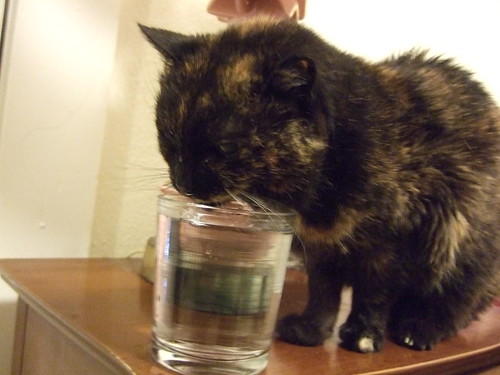
1. Matilda must have very cold water presented to her in a drinking glass, located on the night stand next to our bed. (We found this out the hard way when my wife set a glass out for herself in case she got thirsty during the night)


2009_01250029


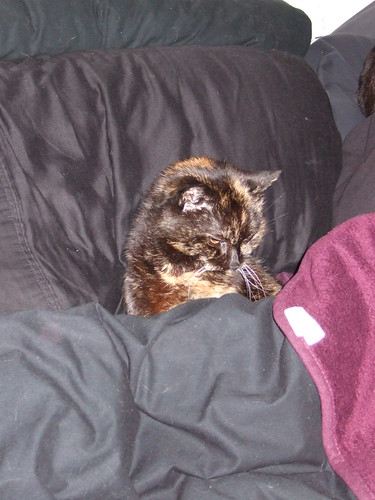
2. Matilda must sleep under the covers and on top of my chest... the moment I lay down for bed each night. This requires me to lift my comforter up so that she can spin around several times on my chest and get comfortable. Other times, she prefers to be tucked in like a human.


cat in bathrobe


3. In the absence of a blanket, Matilda will attempt to crawl under my bathrobe. As you can see, this is only partly successful as there is only so much bathrobe to go around and I am wearing most of it.


DSCF3629


4. Matilda asks that her wet food be served exactly at 7:00 Am and 9:30 PM and will resort to trampling all over me (See: My Alarm Clock is Hungry blog) until I finally give in to her cries for attention and her standing on my wind pipe. Her night time demands are more subtle but still effective.


2007_04010077


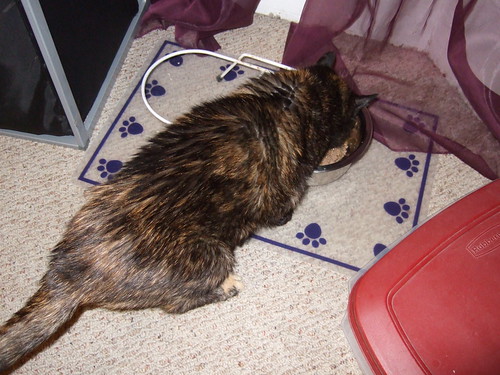
5. Once the food is served, Matilda will have three or four bites of the food, walk away and make herself comfortable in the now empty master bed. She will remain in our bed until roughly 7 pm when we return home.


DSCF3632


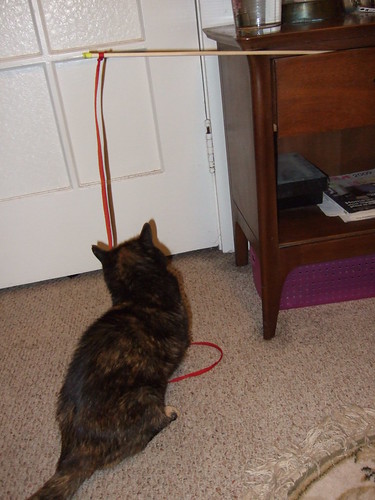
6. For her daily work out session, Matilda requires that a shoe lace attached to a stick be forever dangling from the same night stand she perches on for water. She has decided that she does not need us for this activity. I guess we can't be counted on.


matilda scare


Cat guardians across the country can relate to Matilda's story. Her needs, although not that outlandish... are still her own. Some cats have color preferences, while others may like the way something feels when they lay on it. Ever wonder why a cat will choose to sit on a magazine when there are so many other places to sit? Freedom of choice is a cats prime directive. They do what they want, when they want and there's nothing you can do about it.


Have an interesting and unique story about your cat and its eccentricities? Email it to catbehavior@sfspca.org and we will post it in our upcoming blog!!


And now, a word from a guest blogger:


YOUR CAT WOULD LIKE A WORD WITH YOU


by Rod Kilpatrick
SF/SPCA Cat Volunteer


We've all said it. "Oohh, who's a pretty kitty? You're a pretty kittty! Oh, yes yes yes!"
My own cats, Gary and Sponge, finally divulged to me a closely-held feline secret: They find this kind of talk rather condescending. They'll tolerate it, if it eventually results in a treat or a belly rub. After all, cats are nothing if not realistic. They tell us what they want, what they need, what they love and what they're afraid of, and if we're smart enough to understand, they'll get what they're asking for.


Of course, cat communication is far more subtle than that. If we pay attention to their tone of voice, their body language, their ears and their eyes, we can learn a lot more about what they have to say.

But here's what's really interesting: it's a two-way street. Cats don't speak human any better than we speak cat, so they pick up the very same kinds of non-verbal cues from us that we pick up from them.

Want proof? Well, if you're lucky enough to be owned by a cat, try this. The next time you have a good day, or a bad day, or any kind of day, sit down and talk to your cat about it. Not in some kind of made-up cat language, but in your own language, whether it's English or Espanol or Francais. Exactly the way you'd say it to a human friend.

Your cat may at first look at you as if you're crazy. But keep at it. Eventually, your voice, your face and your body will automatically communicate to your cat in ways that transcend spoken language. And while you might not find answers, I guarantee you'll find at least two sympathetic ears.

So try it. Have a chat with your cat. They always get the last word anyway.


Friday, May 1, 2009

My Cat Ate My Snuggie™

By Daniel Quagliozzi

Has this ever happened to you? You're getting ready for another day at work and you decide to wear your favorite blouse...the very same blouse that has been sitting on the back of your chair for a week because you were too lazy to put it away after you got it back from the cleaners. As you put your arm through the sleeve, you notice there is a soggy hole in the side. Your cat has chewed another chunk out of your wardrobe. What the @*%!?!?! Guess what? Your cat has PICA!

wool3


What Is Pica?

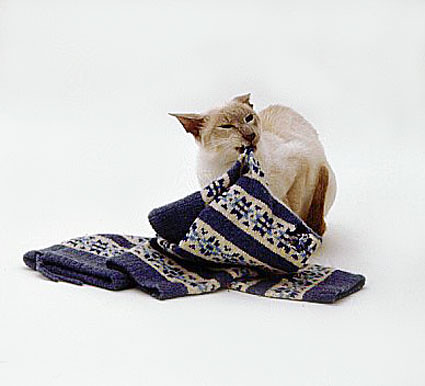
Pica is the term for the repeated ingestion of non-food objects. Accidents will happen, this is true. Sometimes cats will unintentionally eat an object like yarn, string or even a plastic cord. It probably looked like a snake to them? Can you blame them?


Keely_Chewing_on_Plastic_Cat_Rubbing_Toy_3-22-8


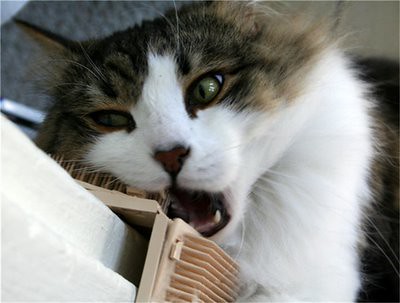
Pica is quite different and happens when cats deliberately chew and swallow inedible materials. Common targets include wool blankets, plastic coated wires, rubber, plastic bags, even thumbtacks, hair ties & spare change . Often, individual cats will have different preferences- so the cat that eats wool may not eat rubber, or the cat that tries to eat your bobby pins may frown upon your hipster sweater. Some cats have a broad range of preferences. Though it might seem amusing to some people, it could result in a lethal ingestion for your cat. Yarn can get wound up in the digestive system and plastic can obstruct major organs. Luckily, most of the time, PICA is more annoying then it is deadly. No one wants to come home to find a huge soggy hole in their favorite shirt.

Wool%20sucking


No one really knows for sure what causes this kind of eating disorder. Some veterinarians attribute it to a lack of fiber in the diet while behaviorist's may claim that it is caused by boredom or anxiety.


woolsucking


To rule out medical causes, a veterinarian should examine all cats displaying pica. Once your veterinarian gives your cat a clean bill of health, discuss with them what steps you can take to modify your cat's behavior. These may include the following:


1. Remove targeted items - Placing clothing, blankets, plastics and electric cords out of the reach of your cat is often the easiest solution. Storage containers, electric cord guards, and other useful items are available at most home supply stores. The upside of all of this is that your house or apartment is going to be super clean! NO MORE CLUTTER! I wish my cat had PICA. It would be great incentive for my wife to stop collecting shoes.


2. Provide alternative items to chew or eat - Food-dispensing toys, durable cat toys, or pieces of rawhide can be used to redirect your cat's chewing behavior to more appropriate and safe items. For cats attracted to houseplants, small flowerpots of grass or catnip can be planted and kept indoors.


3. Provide lots of structured play - Many cats chew on household items out of boredom. Provide interactive toys and set aside time each day to play with your cat. As mentioned in many blogs prior, exercise, play and environmental enrichment provide stimulation that will cure most miss-behaviors. A bored cat has more time to focus it's energy on misbehaving while an active and distracted cat will not have the time of day to devote to such foolish activities.


4. Increase dietary fiber - It may help to increase the amount of fiber in your cat's diet. High fiber foods usually contain fewer calories. Your cat may be able to satisfy their craving to eat more while still maintaining their weight. Consult with your veterinarian before making any changes to your cat's diet.


5. Make targeted items aversive - Occasionally, applying aversive substances (e.g. hot sauce, Bitter Apple®, Bandguard®) to an item may deter a cat from chewing it. If this is not possible, spraying strong smelling substances (e.g. citrus air freshener, potpourri) or using physical deterrents (e.g. upside down carpet runner, Ssscat®, Snappy Trainers®) around an object may prevent cats from approaching. Eventually, your cat will get tired and stop heading for the same places of obsession.


6. Consult with a veterinary behaviorist - If your cat continues to ingest non-food items, referral to a veterinary behaviorist is recommended. Further environmental and behavior modification plans, specifically tailored to your pet, may be needed. In some cases, medication may be helpful. Anti-anxiety medications can lower stress levels and help to subdue the ingestion of non-food items.

chew


Hopefully, with the right guidance and a little bit of tidying up, your cat will no longer bite off anything bigger than they can chew! Buy more cat toys!!!!

Monday, March 23, 2009

Hungry for Love

By Daniel Quagliozzi
DSC_0300


Leaving a home that feels safe and secure for a new adjustment in an animal shelter can be very stressful for some cats. Sometimes the choices made by human guardians struggling with hard situations or compromised living conditions, results in the surrender of a cat that had no idea a huge change was coming.


A common misconception about cat's is that they are quickly adaptable to change. With familiar territory being the most important thing to a cats comfort level, fear, insecurity and the inability to transition to a new environment can take it's toll on a cat's appetite. When a cat feels unsure abouts it's surroundings, it can also be hesitant to do what comes natural like eating or using the litterbox. It's the comforts of home, including the love of a human being that can sometimes perk up a cats emotions and lower stress enough to make food seem yummy again.


It might be hard to relate to the way a cat feels. Often, when we are stressed out we over eat and binge on junk food. When was the last time someone had to keep you company while you ate a pint of Ben & Jerry's? Cats react differently. They actually need human contact to get them back on the road to Wellville.


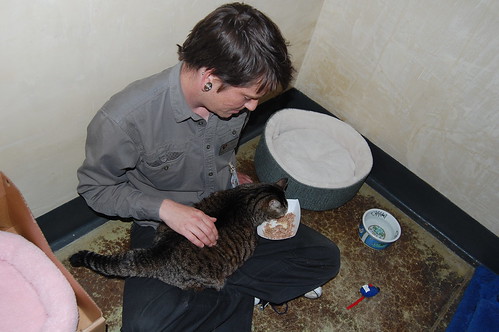
The SFSPCA started the Affection Eaters Program for this very purpose! Trained volunteers and staff will sit with cats on their scheduled feedings to provide the love they so desperately need to eat. This can take days or even weeks for some cats to finally feel well enough to eat without assistance. All it takes is a steady hand for petting, a warm heart and a dish of the cats favorite food. It's as simple as that. The SFSPCA Affection Eater Program has improved the quality of life of many cats that otherwise would have starved themselves sick. Thanks to the time and effort of our Shelter Care staff, volunteers and animal care attendants, the Affection Eaters move on to loving homes without going hungry for love.


DSCF3297

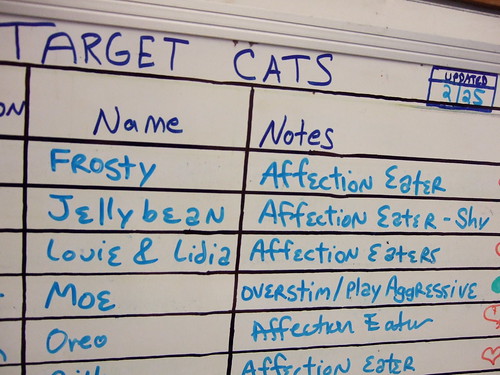
The "Target Board" is a list of cats that need company when they eat or just need special attention. Volunteers check this board for cats that stand out for all kinds of reasons, such as fear, undersocialization, playful aggression and petting induced overstimulation.


We are always looking for volunteers that have skills with cat's of all types as well as those who want to gain the knowledge through their volunteer experience at the SFSPCA.


If you are interested in volunteering to help out with our Affection Eaters Program , it's just a click away! http://www.sfspca.org/support/volunteering/